How to Mine Ancient Debris in Minecraft: Complete Mining Guide
By Editorial
Last updated
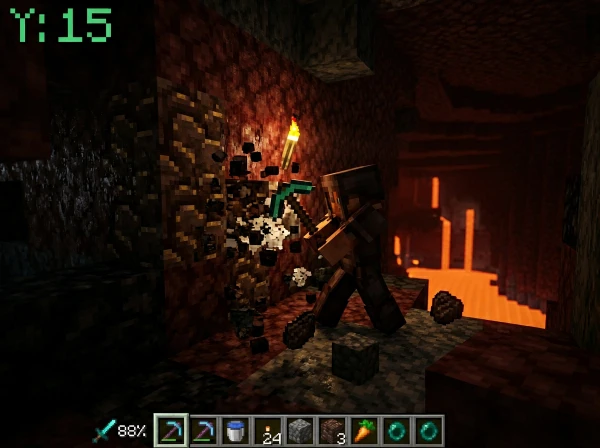
Ancient debris is the only source of netherite in Minecraft.
Mining it requires specific techniques to avoid lava and maximize your haul.
Quick Answer: How to Mine Ancient Debris
Mine ancient debris at Y15 in the Nether using a diamond or netherite pickaxe. Bed mining or TNT mining exposes debris faster than pickaxe mining. Strip mining systematically at Y15 yields maximum ancient debris per hour.
Ancient debris generates between Y8 and Y119 but concentrates heavily at Y15.
Understanding Ancient Debris Mining
Ancient debris only spawns in the Nether dimension, nowhere else.
The ore appears in veins of 1-3 blocks, making it extremely rare.
Unlike other ores, ancient debris generates in small clusters at two different levels: Y15 (primary peak) and Y-119 (secondary).
Key mining facts:
- Requires a diamond pickaxe minimum
- Drops 1 ancient debris per block (no Fortune effect)
- Never burns in lava or fire
- Floats if you drop it in lava
- Takes 15 seconds to break by hand (slow)
The ore’s rarity makes technique critical for efficiency.
What You Need Before Mining
Essential Tools and Items
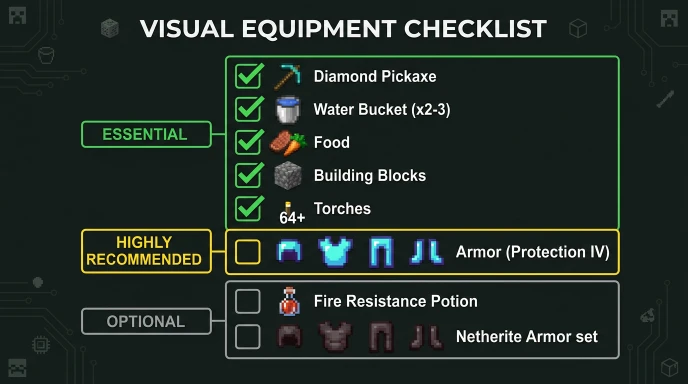
Pickaxe: Diamond or netherite minimum. Stone picks don’t work.
Armor: Protection IV reduces lava damage significantly.
Water buckets: Bring at least 2-3 for lava emergencies.
Food: Stack of cooked meat or golden carrots for healing.
Blocks: 64+ blocks for building and safety.
Torches: Light tunnels to prevent mob spawning.
Optional But Helpful
Fire resistance potions prevent lava damage entirely.
Netherite armor and pickaxe make mining faster and safer.
Efficiency enchantment speeds up mining considerably.
Unbreaking extends pickaxe durability significantly.
Checking Your Y-Coordinate
Press F3 on Java Edition to see coordinates.
The middle number in XYZ is your Y-level.
On Bedrock Edition, enable “Show Coordinates” in world settings.
Constantly check Y-level while mining. Drift to Y18 or Y12 reduces finds by 20-30%.
Strip Mining Strategy at Y15
Setting Up Your Mining Tunnel
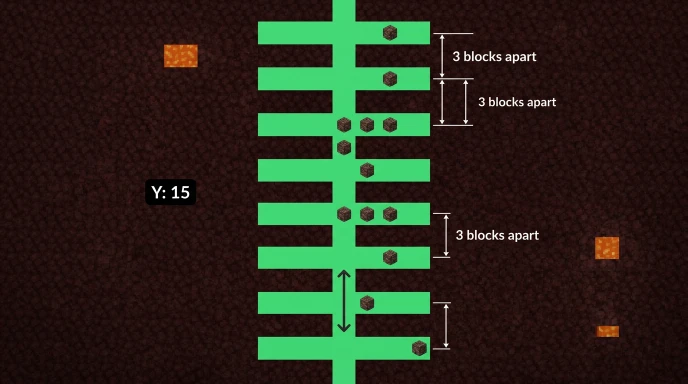
Dig down to Y15 using a safe staircase or water bucket method.
Create a main tunnel extending 200+ blocks in a cardinal direction.
Every 3 blocks, dig perpendicular branches extending 20-30 blocks on each side.
This spacing prevents missing veins while avoiding redundant coverage.
Actual Mining Process
Walk slowly through your branches scanning for ancient debris.
The dark brown/black ore with gold specks is distinctive.
Break each ancient debris block with your pickaxe.
Collect the drops immediately (they float but can be lost).
Mark mined areas with torches to avoid revisiting.
Bed Mining Method (Fastest Technique)
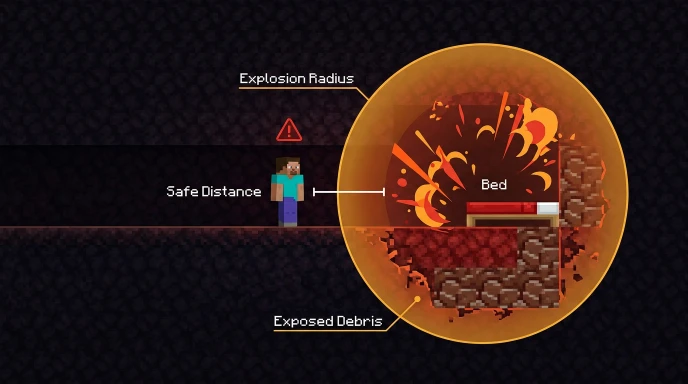
Bed explosions instantly expose large underground areas without mining blocks.
How Bed Mining Works
Place beds at the end of your tunnel.
Stand 2-3 blocks back from the bed.
Right-click the bed to trigger an explosion.
The blast reveals hidden ancient debris in surrounding blocks.
Requirements and Safety
Bring wool and wood for continuous bed crafting.
Keep safe distance or the explosion damages you severely.
Beds require immediate re-crafting after each use (wool + planks).
This method is 2-3x faster than pickaxe mining.
TNT Mining Alternative
TNT works similarly to beds but requires different resources.
TNT Mining Process
Place TNT in your mining tunnel.
Light it with redstone or flint and steel.
Retreat to a safe distance before the explosion.
Collect ancient debris from exposed areas.
When to Use TNT
Use TNT if you have creeper farms producing gunpowder.
Otherwise, bed mining is more resource-efficient.
Both methods work, but beds are faster for most players.
Mining Ancient Debris Efficiently
Avoid These Mistakes
Mining above Y22 or below Y-32 wastes time with minimal results.
Random cave exploration covers less ground than systematic tunneling.
Not bringing water buckets risks losing all your debris to lava.
Breaking ancient debris without proper tools takes 15+ seconds per block.
Ignoring Y-coordinates and drifting causes you to miss the optimal range.
What Actually Works
Strip mining at Y15 yields 1-3 ancient debris per 100 blocks mined.
Bed mining finds debris twice as fast but costs resources.
Staying exactly at Y15 prevents wasted effort in lower-yield zones.
Mining Speed Comparison
| Method | Speed | Safety | Resource Cost | Best For |
|---|---|---|---|---|
| Pickaxe Strip Mining | Slow | Safe | Low | Beginners |
| Bed Mining | Fast | Medium | Medium | Experienced |
| TNT Mining | Very Fast | Low | High | Powder-rich |
| Cave Exploration | Medium | Low | Low | Finding debris |
Strip mining at Y15 is the most reliable method.
Lava Management While Mining
Lava lakes are extremely common at Y15 and below.
Safe Lava Handling
Keep water buckets in your hotbar at all times.
Pour water on lava before mining near it.
Build a block barrier before breaking into lava pockets.
Never mine directly into unknown areas.
Lava immunity potions make this risk vanish completely.
Using OreFinder to Find Ancient Debris
Manual mining can take 10+ hours for full netherite gear.
Ore Finder maps exact ancient debris locations using your Nether seed.
Enter your seed and select ancient debris as the ore type.
The tool shows every debris vein with precise X, Y, Z coordinates.
Navigate directly to debris-rich chunks instead of mining blind.
This approach cuts your mining time by 60-70%.
For more details on ancient debris spawn mechanics, check our complete Y-level guide.
How Much Ancient Debris Do You Need
For one netherite ingot: 4 ancient debris blocks minimum.
Full netherite armor set: 24 netherite ingots = 96 ancient debris blocks.
Complete tools and armor: 35+ netherite ingots = 140+ ancient debris blocks.
Most players need 50-100 ancient debris for essential gear.
Biome-Specific Mining Considerations
Ancient debris spawns identically in all Nether biomes.
Nether Wastes: Sparse desert-like terrain, easy navigation.
Crimson Forest: Dense trees, difficult to navigate, harder mining.
Warped Forest: Similar to crimson, confusing purple trees.
Soul Sand Valley: Slow walking speed, oppressive atmosphere.
Basalt Deltas: Hardened material makes mining slower.
Choose biomes based on navigation ease, not debris concentration.
Preserving Your Ancient Debris
Ancient debris floats in lava (doesn’t burn).
If you accidentally drop it in lava, it floats safely.
Retrieve it before leaving the mining area.
Consider dropping items in water buckets for safekeeping during long sessions.
FAQ
How do you mine ancient debris in Minecraft?
Mine with a diamond or netherite pickaxe at Y15 in the Nether. Strip mine systematically or use bed mining for speed. Ancient debris appears in veins of 1-3 blocks. Bring water buckets for lava safety. One pickaxe stroke breaks each block dropping the debris.
What’s the fastest way to mine ancient debris?
Bed mining is fastest, exposing debris 2-3x quicker than pickaxes. Requires beds (wool + wood) and managing explosion damage. TNT mining works similarly but requires more resources. Strip mining at Y15 is the slowest but safest for beginners.
How much ancient debris do you need for full netherite?
You need 96 ancient debris blocks for full netherite armor (24 ingots × 4 scraps each). Add tools and weapons for 120-150 total. This requires significant Nether mining or multiple sessions.
Can you mine ancient debris with a stone pickaxe?
No. Stone pickaxes break ancient debris without dropping it. You need an iron pickaxe minimum, but a diamond pickaxe is recommended. Netherite pickaxe is the fastest but requires ancient debris first.
Where do you find ancient debris to mine?
Ancient debris spawns only in the Nether between Y8 and Y119. Peak concentration is at Y15. Mine systematically at this Y-level for maximum efficiency. Use Ore Finder to find exact debris coordinates.
Mine Ancient Debris Efficiently
Ancient debris mining requires preparation, patience, and the right technique.
Y15 is your target level for maximum yield.
Use systematic strip mining or bed mining based on your resources.
Get your seed to OreFinder.io and skip random mining entirely.
Start mining today and get netherite gear faster than ever.